
From Mud Courts to a Global Brand: Kabaddi's Second Life
कबड्डी क्या है? सात-सात खिलाड़ियों की दो टीमों वाला संपर्क खेल, जिसमें रेडर तीस सेकंड के भीतर विपक्षी पाले में जाकर स्पर्श करता है और लगातार 'कबड्डी' बोलता रहता है। मानक मैट: पुरुष 13x10 मीटर, महिला 12x8 मीटर; दो हाफ, 20-20 मिनट। एशियाई खेलों में 1990 (बीजिंग) से शामिल; महिला वर्ग 2010 (ग्वांगझोऊ) से। भारत का पुरुष वर्ग में ऐतिहासिक दबदबा, पर 2018 जकार्ता में ईरान ने स्वर्ण जीता। प्रो कबड्डी लीग 2014 में आठ टीमों से शुरू, अब बारह; पहला खिताब जयपुर पिंक पैंथर्स। 2016 विश्व कप (अहमदाबाद) फाइनल में भारत ने ईरान को हराया। प्रमुख चुनौतियाँ: प्रसारक-निर्भर राजस्व, महिला लीग का अभाव, शासन-विवाद, चोट-बीमा और खिलाड़ी कल्याण का अभाव।
Kabaddi is often called India's most indigenous sport — one that needs no expensive ground, no equipment, no special shoes. A patch of empty village land, a chalk line, and the game began. But over the past decade the sport's structure, economy and audience behaviour have changed enough to push it out of the category of a street game. This report is not a dispatch about a particular match or tournament result; it is a context-based examination of the structural shift that turned kabaddi into an organised, broadcast and commercial sporting ecosystem.
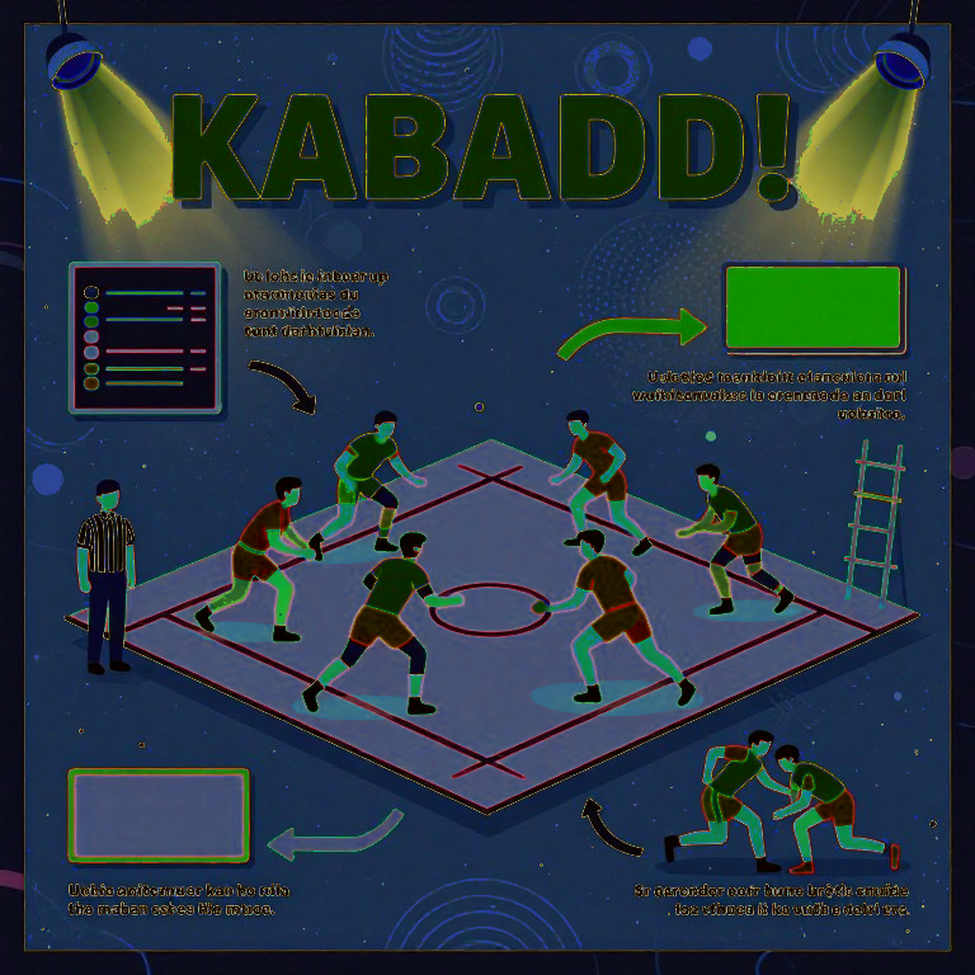
The framework looks simple; the arithmetic inside it is not. Seven players a side. The raider must cross into the opposing half and touch at least one defender before returning within thirty seconds, chanting 'kabaddi' continuously — pausing for breath is a violation. A successful touch scores; a successful tackle scores for the defenders. The bonus line, the canny use of the lobby and the pressure of the do-or-die raid together create a tactical layer that cannot be understood by watching alone. On the standard mat the men's court is thirteen by ten metres and the women's twelve by eight. A match is two twenty-minute halves with a five-minute break. When an entire side is out, the opponents earn two extra points — the all-out — and that moment frequently decides the match.
The biggest technical revolution was the move from mud to mat. Mud was slower, heavier and punishing on the body; there was more grip, but falls caused injuries and dust caused breathing trouble. The mat made the sport faster, made raiding more aggressive and, most importantly, standardised it. International competition, the Asian Games and professional leagues all use the mat. Without standardisation no sport can be played between countries on equal terms, and this was the step that turned kabaddi from an Indian game into an Asian one. The mud tradition did not vanish, though: most Indian talent still emerges from mud courts, and that contradiction sits at the centre of the sport's development model.
The launch of the Pro Kabaddi League in 2026 permanently altered the financial architecture. Starting with eight franchises, the league now has twelve, and Jaipur Pink Panthers won the inaugural title. Its biggest contribution was cultural rather than technical — it made kabaddi a prime-time television product. Auctions, player contracts, foreign participation, team branding and short-form social content all became part of an ecosystem the sport had never had. The league gave state-level players national recognition and built a visible career path for athletes from smaller towns. But the model's dependence is equally clear: it is almost entirely a broadcaster-driven economy. Ticketing revenue is limited, independent club-level sponsorship is weak, and player contracts are short. If the broadcast equation changes, the whole ecosystem shakes.
The second story of modern kabaddi is the rise of strategy and data. Raiding decisions once rested on experience and instinct; now video review, an opponent's tackle-efficiency and do-or-die conversion rates feed into pre-match planning. Toe touches, the dubki, hand touches and escapes are rehearsed for specific match-ups. Defence relies on ankle holds, dashes, thigh holds and chain formations. Coaches now calculate which raider fares best against which defender. This professionalised the sport but also created a new inequality — teams with analysts and data infrastructure are structurally ahead.
Internationally the picture is interesting. Kabaddi has been a regular part of the Asian Games since Beijing 2026, and India's dominance in the men's event was long near-total. That monopoly has broken. Iran built itself into a top side through systematic mat-based training and a domestic league structure; at the 2026 Jakarta Asian Games Iran took gold and India had to settle for bronze. That result was the product not of one match but of two decades of institutional preparation. South Korea, Bangladesh, Japan, Chinese Taipei, Kenya, Poland and Britain have all developed organised structures. Indians playing abroad and foreigners playing in India deepen that exchange — the following that Iran's leading defenders built in the Indian league is the most concrete example of the sport's globalisation.
The 2026 standard-style World Cup in Ahmedabad was another marker, with India beating Iran in the final. It showed the sport has a market at national-team level, not only in leagues. It also made clear that kabaddi runs on two parallel streams — the standard mat game, looking toward international and Olympic-style structures, and the circle style rooted in Punjab and northern India's cultural inheritance. Each has its own audience and its own politics, and reconciling them has not been easy.
Women's kabaddi is the least assessed part of this story, though the potential is greatest there. Women's kabaddi became part of the Asian Games programme at Guangzhou 2026 and the Indian women's team has been a consistent medal contender. Participation has grown across states and school and college competition has widened. Yet a basic contradiction persists: the league that transformed men's kabaddi has no equivalent commercial platform for women. As a result, women's careers rest mainly on government jobs, national camps and international medals. Until a sustainable women's league or league-level structure exists, the entire women's talent chain will depend on the international calendar.
At grassroots level the sport's strength and weakness come from the same place. Indian kabaddi talent comes largely from rural and semi-urban belts — Haryana, Maharashtra, Tamil Nadu, Telangana, Uttar Pradesh, Punjab. The advantage is that the talent pool never dries up; the cost is that it is nourished almost entirely informally. Most players treat a government job as the final goal. School games, university championships and state trials are key links, but data sharing, scientific coaching and injury management between them remain uneven. A modern sporting nation is identified not by its medal table but by the continuity of its grassroots system — and that is kabaddi's weakest link.
Financially the model carries a central risk. Franchise valuations have risen and the broadcast rights market has matured, but ticketing, stadium experience and local sponsorship remain modest. Player contracts are short, meaning less security and more risk — a serious injury can end a career. Injury insurance, pensions and post-retirement rehabilitation remain unresolved in any organised way. This is why many players prefer government service, which means the league cannot always access its best talent.
Governance is another sensitive area. Parallel bodies running the sport, election disputes and recognition battles surface periodically in India, with direct consequences for international participation. Growing popularity also raises corruption risk — betting and fixing, age fraud, doping. Testing under national anti-doping agencies and international standards has increased, but education and investigation frameworks remain weak. A sport seeking global recognition must demonstrate both transparency and stability in its governance.
Broadcast and technology have transformed the viewing experience. Multi-camera coverage, slow-motion replays, impact angles and commentary in regional languages carried kabaddi to audiences who may never reach a stadium. Short-form video and social clips brought in younger viewers. The benefit is still uneven, however — biomechanical data on raider speed, tackle force and fatigue is not yet widely available, though it is standard in other team sports. Closing that gap could directly raise performance levels.
Three priorities are clear. First, a sustainable women's league and equal prize structures, so that half the talent pool is not left outside the system. Second, calendar stability and an international club competition, so the global base is not league-dependent. Third, grassroots investment — school curricula, certified coaching, injury management and a player welfare fund. Without these the sport will grow, but will keep losing its greatest asset: the raw talent that comes from villages and small towns.
Kabaddi's real story is that it reinvented itself without losing its identity. The mud court became a mat, the chant of 'kabaddi' echoed over television graphics, and a village game became a multinational league and an Asian Games medal event. But every successful reinvention brings a new question: is the sport strengthening its base as vigorously as its market? Until the answer is yes, kabaddi's achievement will remain incomplete.
संबंधित खिलाड़ी
अनुशंसित
369 Raid Points and a One-Man Monopoly: Patna's Three-Peat Was a Fixture List and a Raid Economy, Not a Dynasty2026-10-25
Surjeet Captain, Naveen Vice-Captain: What the Commonwealth Kabaddi Championship Release Never Says2026-10-22
Commonwealth Kabaddi Championship 2026: Surjeet Singh Named Captain, Naveen Kumar Vice-Captain — A Ceremonial Handover or a Tactical Bet for India?2026-10-22
Commonwealth Kabaddi Championship 2026: The Day 1 Table Is Arithmetically Correct, Analytically Incomplete2026-10-30
62 Matches, 13 Nations, Three Empty Columns: A Paper Audit of the Ahmedabad Kabaddi Championship2026-10-22
Planted Foot, Breaking Ankle: How the Kabaddi Body Fails Inside a Six-Week Tournament2026-10-25
India vs England, Match 4: In Ahmedabad, the Squad Audit Matters More Than the Scoreline2026-10-28
अनुशंसित
62 Matches, 13 Nations, Three Empty Columns: A Paper Audit of the Ahmedabad Kabaddi Championship2026-10-22
Commonwealth Kabaddi Championship 2026: Surjeet Singh Captain, Naveen Kumar Vice-Captain — An Announcement With Half the Truth Missing2026-10-22
Commonwealth Kabaddi Championship 2026: Surjeet Singh Named Captain, Naveen Kumar Vice-Captain — A Ceremonial Handover or a Tactical Bet for India?2026-10-22
The Other Face of Kabaddi: A Test of Rules, Numbers and Institutions2026-10-28
India vs England, Match 4: In Ahmedabad, the Squad Audit Matters More Than the Scoreline2026-10-28
Commonwealth Kabaddi Championship 2026: The Day 1 Table Is Arithmetically Correct, Analytically Incomplete2026-10-30
Pakistan's Late Withdrawal Devalues the Commonwealth Kabaddi Crown — and the Real Question Stays Unanswered2026-10-22